While I was pregnant I let go of some of the dietary changes I had made for environmental reasons. I ate fewer vegetarian meals and more dairy and fish. One thing I held onto was that I still tried to buy the best fish I could according to the Forest & Bird Best Fish Guide.
It's pretty hard to find fish species from the green section of the guide, especially at supermarkets. One of the best fish I bought was trevally, from the fish shop at the top of Cuba St.
It's pretty under-rated, I reckon. I served it up to dinner guests one night and it was great. My guests liked it so much they even asked what kind of fish it was.
Friday, November 23, 2012

Wednesday, November 7, 2012
Suburban Compost Mum
It's been a long time since my last post and in that time my life has radically changed.
Since January I've moved in with my partner - which has involved moving from an inner city apartment to a house in the suburbs of Lower Hutt - and we've had a baby.
This has been a huge challenge to many of my "green" practices. I'm no longer a free and easy singleton who has plenty of disposable income, makes all the decisions in their domestic life and lives within walking distance of everything. Now our income has halved, I have to negotiate a compromise with my partner on all the household systems (recycling, grocery shopping, cleaning) and it's a mission to go anywhere without driving. Plus I've got a baby to think about.
Meanwhile climate change hasn't gone away, the Great Pacific Garbage Patch hasn't got any smaller and species are still becoming extinct. How am I going to figure out how to keep sustainability a part of my life as a suburban mum?
Since January I've moved in with my partner - which has involved moving from an inner city apartment to a house in the suburbs of Lower Hutt - and we've had a baby.
This has been a huge challenge to many of my "green" practices. I'm no longer a free and easy singleton who has plenty of disposable income, makes all the decisions in their domestic life and lives within walking distance of everything. Now our income has halved, I have to negotiate a compromise with my partner on all the household systems (recycling, grocery shopping, cleaning) and it's a mission to go anywhere without driving. Plus I've got a baby to think about.
Meanwhile climate change hasn't gone away, the Great Pacific Garbage Patch hasn't got any smaller and species are still becoming extinct. How am I going to figure out how to keep sustainability a part of my life as a suburban mum?
Monday, January 2, 2012
Plastic-free international travel
While I was on my big trip I still tried to find ways to avoid using plastic as much as possible. Beth Terry blogged on this a while ago - all good ideas, but more appropriate for travelling within the United States where she lives, rather than spending a couple of months travelling around on the other side of the world.
I wasn't heroic enough to try to work out how to take all my own food on a 12-hour flight leaving from a foreign city! But I tried to do what I could.
The things I found to be simplest and most effective:
Overall it wasn't too hard to avoid plastic in France and Spain. For example, I also took my own collapsible cup and knife, fork and spoon set, but only used them a few times because most of the time I ate in at restaurants that used real cutlery and china.
Unexpected plastic did pop up in a few places though - like the ice cream in a cone that came with a little plastic spoon in Madrid, or the little plastic cap protecting the ice cream on the Spanish version of a Trumpet. That's just a part of travelling.
I wasn't heroic enough to try to work out how to take all my own food on a 12-hour flight leaving from a foreign city! But I tried to do what I could.
The things I found to be simplest and most effective:
- Taking your own snacks/lunch on buses and trains.
- Eating before you head to the airport or taking your own food
- Taking your own water bottle and refilling it from the tap at your accommodation each day.
- Taking a reuseable shopping bag.
Overall it wasn't too hard to avoid plastic in France and Spain. For example, I also took my own collapsible cup and knife, fork and spoon set, but only used them a few times because most of the time I ate in at restaurants that used real cutlery and china.
Unexpected plastic did pop up in a few places though - like the ice cream in a cone that came with a little plastic spoon in Madrid, or the little plastic cap protecting the ice cream on the Spanish version of a Trumpet. That's just a part of travelling.
Saturday, December 31, 2011
Unpackit - cute packaging awards
Wanaka Wastebusters have come up with a cute packaging award website to out the worst packaging culprits in the country (and shine a light on the best).
The nomination that resonates most with me is the packages of individually wrapped prunes - crazy stuff.
The nomination that resonates most with me is the packages of individually wrapped prunes - crazy stuff.
Sunday, December 11, 2011
Plastic-free picnics?

I bought this beautiful picnic lunch in Paris, at the local shops in Montmartre, where I was staying.
It was a charming experience. I bought the bread from the bakers; the incredibly smelly but quite delicious cheese from the little cheese shop; and the fruit from the fruiterers.
And the photo shows 100% of the packaging involved. The cheese was just wrapped up for me in a piece of paper and the blueberries came in that little cardboard tray. I popped the bread straight into my own cotton carry bag, no problem.
Voila, plastic-free picnic.
Whole other story in the UK. This is the picnic I bought from Marks & Sparks in Inverness:

This was the least-plastic-packaging lunch I could come up with after probably 20 mins of prowling around the aisles. And, y'know, supermarkets - really not so charming.
Guess which one was yummier??
Thursday, October 27, 2011
Climate change election debate
It's the start of the election campaign. Last night I went to a climate change election debate hosted by Oxfam.
I was fascinated that while political parties thought it was worth sending the cabinet minister for climate change (Nick Smith), the leader of one of the political parties (Russel Normal of the Greens)and the opposition spokesperson for climate change (Labour's Charles Chauvel) to take part, and Adrian Macey, chair of the UN climate change talks also attended, there were only about 150 people in the audience, many of whom were the usual suspects.
Both climate change and the ETS/global political environment favouring mechanisms to reduce greenhouse gas emissions seem like they have the potential to change our lives more significantly than most other issues that might be debated in this election so you'd think people might be more interested.
Points I was interested in from the debate:
Both Labour and National were pessimistic about a replacement to the Kyoto agreement being agreed before the current commitment period runs out in 2012. Therefore NZ may have no ongoing financial commitments.
The Maori Party's stance tries to balance protecting low-income earners from rising costs with taking a kaitiaki role. It appears to focus on tweaking climate policy to help benefit Maori, such as subsiding reafforestation for carbon sinks on the East Cape.
The Greens originally favoured a carbon tax and redistribution of revenue. Their current climate change policy/emissions reduction plan includes purchasing international offsets.
Labour's line is that the lignite in Southland would stay in the ground. No state company would mine for it and any new company would pay the full costs of emissions. But deep sea drilling would be allowed with appropriate safeguards.
National tosses up between various possible uses for the Southland lignite (urea, briquettes or diesel production).
Nick Smith talked about "good" fracking and "bad" fracking - "bad" shallow fracking that shouldn't be allowed and "good" fracking that relates to geothermal exploration.
Nick Smith, as ever, was the consummate politician. However, when he tried to claim credit for National for implementing the ETS it did draw a laugh from the crowd.
I was fascinated that while political parties thought it was worth sending the cabinet minister for climate change (Nick Smith), the leader of one of the political parties (Russel Normal of the Greens)and the opposition spokesperson for climate change (Labour's Charles Chauvel) to take part, and Adrian Macey, chair of the UN climate change talks also attended, there were only about 150 people in the audience, many of whom were the usual suspects.
Both climate change and the ETS/global political environment favouring mechanisms to reduce greenhouse gas emissions seem like they have the potential to change our lives more significantly than most other issues that might be debated in this election so you'd think people might be more interested.
Points I was interested in from the debate:
Both Labour and National were pessimistic about a replacement to the Kyoto agreement being agreed before the current commitment period runs out in 2012. Therefore NZ may have no ongoing financial commitments.
The Maori Party's stance tries to balance protecting low-income earners from rising costs with taking a kaitiaki role. It appears to focus on tweaking climate policy to help benefit Maori, such as subsiding reafforestation for carbon sinks on the East Cape.
The Greens originally favoured a carbon tax and redistribution of revenue. Their current climate change policy/emissions reduction plan includes purchasing international offsets.
Labour's line is that the lignite in Southland would stay in the ground. No state company would mine for it and any new company would pay the full costs of emissions. But deep sea drilling would be allowed with appropriate safeguards.
National tosses up between various possible uses for the Southland lignite (urea, briquettes or diesel production).
Nick Smith talked about "good" fracking and "bad" fracking - "bad" shallow fracking that shouldn't be allowed and "good" fracking that relates to geothermal exploration.
Nick Smith, as ever, was the consummate politician. However, when he tried to claim credit for National for implementing the ETS it did draw a laugh from the crowd.
Tuesday, October 25, 2011
British supermarkets
INSANE.
That is the only word for British supermarkets.
From a distance I had been really envious of how "green" supermarkets in the UK seemed - creating demand for Marine Stewardship Council certified fish, giving information on food miles, stocking organic food ...
Then this is what I found when I got up close:
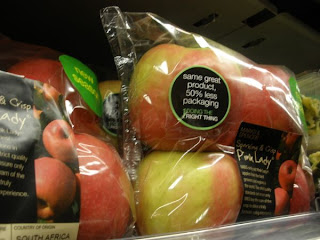
Yes, that is four apples on a black plastic tray sealed in a plastic bag WITH A LABEL proudly claiming that this is LESS PACKAGING.
That's just bonkers.
And did you notice the little label at the bottom left? South African apples.
I bought picnic lunches at the supermarket a few times and tried really hard to find fruit that was grown in the UK. There was stuff from Spain, Italy and France but the only thing I could find from Britain was strawberries in plastic punnets.
OK, I figured, it's June, it's still only late spring, not really a good season for fruit. Maybe I'll get some vegies instead. I turned to the vegie aisle. There was an amazing variety of vegetables on display. Salad greens, lettuces, cucumbers, I think there were tomatoes. There were little plastic packets of green beans from Africa that must surely have been air-freighted. But the only vegetables from Britain were peas.
And everyone else was shopping like this was COMPLETELY NORMAL.
I was gobsmacked.
All those things that I had admired - the recyclable packaging, the Forest Stewardship Council certified cardboard, the country-of-origin labelling - now I just see it as a big greenwash.
That is the only word for British supermarkets.
From a distance I had been really envious of how "green" supermarkets in the UK seemed - creating demand for Marine Stewardship Council certified fish, giving information on food miles, stocking organic food ...
Then this is what I found when I got up close:

Yes, that is four apples on a black plastic tray sealed in a plastic bag WITH A LABEL proudly claiming that this is LESS PACKAGING.
That's just bonkers.
And did you notice the little label at the bottom left? South African apples.
I bought picnic lunches at the supermarket a few times and tried really hard to find fruit that was grown in the UK. There was stuff from Spain, Italy and France but the only thing I could find from Britain was strawberries in plastic punnets.
OK, I figured, it's June, it's still only late spring, not really a good season for fruit. Maybe I'll get some vegies instead. I turned to the vegie aisle. There was an amazing variety of vegetables on display. Salad greens, lettuces, cucumbers, I think there were tomatoes. There were little plastic packets of green beans from Africa that must surely have been air-freighted. But the only vegetables from Britain were peas.
And everyone else was shopping like this was COMPLETELY NORMAL.
I was gobsmacked.
All those things that I had admired - the recyclable packaging, the Forest Stewardship Council certified cardboard, the country-of-origin labelling - now I just see it as a big greenwash.
Subscribe to:
Posts (Atom)
