Showing posts with label purchasing power. Show all posts
Showing posts with label purchasing power. Show all posts
Friday, February 22, 2013
Conscious Consumers go mobile
Conscious Consumers have created a smartphone app to help you find accredited cafes and restaurants while you're on the move. Nice.

Monday, February 11, 2013
Gifts and guests
I've mentioned this before - I really struggle with trying to be sustainable when it comes to stuff for other people: giving gifts, having people around etc. When I buy stuff excessively packaged in plastic, or *ahem* fly to the other side of the world, it's often because I want to do something that's nice for someone else.
I was interested to read a really clear explanation of this conflict in Niki Harre's Psychology for a Better World (see the chapter on identity; also pp. 137-138). There are a lot of big ideas in this book. One is that you want to act in a way that is consistent with your identity, but in your life you have multiple identities that are sometimes in conflict. In this case, you are a greenie - so you want to be environmentally responsible - but you are also a mother/daughter/sister/friend and a member of a society that traditionally gives gifts - so you want to give a nice gift.
She also explains that you empathise much more easily with one person, especially one similar to you, than you do with any more than one. (Millions of people will suffer because of climate change vs your Nan will really like this present? Nan wins, hands down.)
So it's not just me! It is actually really hard to reconcile wanting to act in a sustainable way with wanting to do something nice for someone else, when those two things are in conflict.
So, Christmas is kind of hard. I think maybe the solution is to resolve the conflict by being creative and coming up with a solution that is both sustainable AND nice for someone else.
There are some excellent present ideas that are both nice to get and local/eco-friendly.
Who wouldn't want a gift voucher for a cleaner to come in and clean your house?!
Tuesday, October 25, 2011
British supermarkets
INSANE.
That is the only word for British supermarkets.
From a distance I had been really envious of how "green" supermarkets in the UK seemed - creating demand for Marine Stewardship Council certified fish, giving information on food miles, stocking organic food ...
Then this is what I found when I got up close:
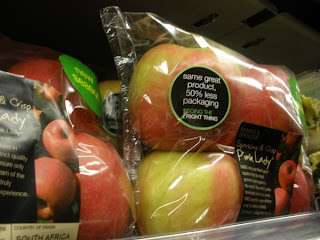
Yes, that is four apples on a black plastic tray sealed in a plastic bag WITH A LABEL proudly claiming that this is LESS PACKAGING.
That's just bonkers.
And did you notice the little label at the bottom left? South African apples.
I bought picnic lunches at the supermarket a few times and tried really hard to find fruit that was grown in the UK. There was stuff from Spain, Italy and France but the only thing I could find from Britain was strawberries in plastic punnets.
OK, I figured, it's June, it's still only late spring, not really a good season for fruit. Maybe I'll get some vegies instead. I turned to the vegie aisle. There was an amazing variety of vegetables on display. Salad greens, lettuces, cucumbers, I think there were tomatoes. There were little plastic packets of green beans from Africa that must surely have been air-freighted. But the only vegetables from Britain were peas.
And everyone else was shopping like this was COMPLETELY NORMAL.
I was gobsmacked.
All those things that I had admired - the recyclable packaging, the Forest Stewardship Council certified cardboard, the country-of-origin labelling - now I just see it as a big greenwash.
That is the only word for British supermarkets.
From a distance I had been really envious of how "green" supermarkets in the UK seemed - creating demand for Marine Stewardship Council certified fish, giving information on food miles, stocking organic food ...
Then this is what I found when I got up close:

Yes, that is four apples on a black plastic tray sealed in a plastic bag WITH A LABEL proudly claiming that this is LESS PACKAGING.
That's just bonkers.
And did you notice the little label at the bottom left? South African apples.
I bought picnic lunches at the supermarket a few times and tried really hard to find fruit that was grown in the UK. There was stuff from Spain, Italy and France but the only thing I could find from Britain was strawberries in plastic punnets.
OK, I figured, it's June, it's still only late spring, not really a good season for fruit. Maybe I'll get some vegies instead. I turned to the vegie aisle. There was an amazing variety of vegetables on display. Salad greens, lettuces, cucumbers, I think there were tomatoes. There were little plastic packets of green beans from Africa that must surely have been air-freighted. But the only vegetables from Britain were peas.
And everyone else was shopping like this was COMPLETELY NORMAL.
I was gobsmacked.
All those things that I had admired - the recyclable packaging, the Forest Stewardship Council certified cardboard, the country-of-origin labelling - now I just see it as a big greenwash.
Monday, July 18, 2011
The main trunk line
My main effort at making my Europe trip a little bit greener was to commit to not making any domestic flights. Everywhere that I reasonably could, I took the train.
So, the very first thing I noticed was that of all the places I wanted to travel (Spain, France, the UK) the only train journey that didn't have a scheduled service every day was between Wellington and Auckland.
That's right - the train between two of our main centres only runs three days a week in the winter. How crazy is that? I guess so many people fly instead that it's not viable to run more often.
But I reckon the train service is really valuable. It creates about 1/8th the carbon emissions of flying. It would be terrible if it stopped running altogether.
So I'm glad that I put my money into supporting it.
And, damn, it's a beautiful journey.
Sunday, January 23, 2011
Organic vegetables, bees, butterflies and hoverflies
I've switched to buying organic vegetables.
I'd been thinking about it for a while, because of all that good stuff about organics (more carbon held in the soil, less fertiliser runoff into waterways, more biodiversity) but it took me a while to decide to make the change - because organic does cost more.
While I was dithering, I read a blog post that reminded me about the worldwide problem with declining pollinators.
And I thought to myself: "I think I can't afford an extra $10 or 15 a week for vegetables, but I think I can afford to live in a world without bees?"
I guess we don't yet know for sure the reason that bees are declining, but it reminded me that my expectations about the price of food might be based on a slightly screwed-up system.
Sunday, November 14, 2010
Plastic-free basil

Look at this marvellous piece of marvellousness!
Last year I had to buy basil in a plastic pot (grumble grumble) but this year I found basil seedlings for sale in a recycled takeaway coffee cup.
Good on you Grow from Here.
Sunday, August 22, 2010
Conscious Consumers
This is a nice little initiative by the non-profit 42 Collective:
Conscious Consumers
It's a Wellington-based project to award cute badges to cafes that follow "sustainability" practices (fair trade, composting, organic, seasonal produce, recycling, allowing BYO cups, eco-friendly cleaners, free-range eggs, compostable packaging).
It's worth checking out the details of the badges on the website - requirements for earning some of them are pretty mild (for example, to qualify for the "seasonal produce" badge, only three dishes on the menu need to use entirely seasonal produce).
Cafes do get charged to belong, which might explain obvious omissions such as People's Coffee (who obviously could qualify for the Fair Trade badge). Badges are awarded mainly based on the declarations of the cafes, although 42 Collective "reserve the right to audit".
I've yet to spot the badges in cafe windows, but the website is handy for finding which cafes belong.
I'll definitely be more likely to go to Meow for my cafe treats - the closest cafe that promises to use organic milk!
Update Nov 2010:
Conscious Consumers is growing - People's Coffee have joined up and the website has about 20 cafes in total now. It's tipped to spread to Auckland soon!
Thursday, August 5, 2010
But what can I do?
Sometimes I find all the bad news about the state of the planet overwhelming and start to think "But what can I do?"
In these moments I often find myself turning to a touchstone - a list of actions put together by Jared Diamond in Collapse.(It's buried back in the "Further Reading" section, pp. 555-560.)
He says there are half a dozen things every individual can usefully do:
1. Vote (and let your elected representative know your views).
2. Reconsider what you do and don't buy.
3. Draw public attention to the policies and actions of companies (he recommends praising the good as well as condemning the bad). He also points out that it's more effective to target retailers and brands that sell to the public, because they are the most sensitive to consumer pressure.
4. Talk to others who vote and buy.
5. Be involved in work to improve your local environment.
6. Donate money to environmental organisations.
I think it's a good list.
Thursday, May 6, 2010
Hard-wearing shoes
Shoe lovers, I have two words for you: Minnie Cooper.
My discovery of the week - I bought a pair and I'm besotted with them!
They are:
- made in New Zealand
- all leather, apart from the heel and the sole plate they recommend you get put on
- repairable-looking - you could replace the heel and the sole plate when they get worn
They're not cheap, but I'm optimistic they will last long enough to make up.
And did I mention pretty? :)
Other notes I've gleaned about good and bad shoe brands:
Wore out quickly:
Hush Puppies
Miss Sophie
All Stars
Seemed to last well:
DV8
Sole shoes
Tuesday, April 27, 2010
Even more plastic-free takeaways
I've updated the plastic-free takeaways post again, this time thanks a hasty dinner at McDonalds.
Although my quarter-pounder and fries were in fact plastic free, I did notice that I was eating 75% of my daily fat allowance in one sitting. But I leave that part of the choice up to your nutritional conscience :)
Also interesting to see a strong split between food styles: fish and chips, pizza and burgers come out generally low in plastic; various Asian takeaways (Chinese, Thai, Indian, sushi) seem to be mostly plastic-y.
Sunday, April 25, 2010
Hill St farmers' market
It was my first visit to the Hill St Farmers' Market yesterday.
First thought: So that's where the organic vegie stall has gone to from the Victoria St market.
Second thought: Hmm, it is a bit of a chichi, high-end market, aimed at the eco-affluent rather than a dirt-under-the-fingernails farmers market (stalls with chocolates, cupcakes, olive oil etc. rather than earthy vegies and half sides of sheep).
Third (excited) thought: Fish?!
And there it was: Splashzone, a van selling fish caught locally off the Wairarapa coast. They say they're a family business and catch under the quota management system.
I asked and they said they catch the fish either with lines (for hapuku and one other species) or with nets. What kind of nets? I asked. They looked at me like I was a little crazy and said they had nets with different-sized holes for different species.
I guess I was thinking: gillnet? purse seine net? They didn't really give me quite enough information to know, but from the photos on the website it's clearly a small boat with small nets, so I'm thinking this isn't bottom trawling or one of those operations with nets so big you can fit a fleet of aeroplanes through the mouth. So I reckon it's probably not too bad as commercial fishing goes.
And they gave me a scoop of chipped ice in the bag to take my smoked lemonfish home in. Nice.
Plastic-free meat
If you ask at the deli counter at the supermarket (New World, anyway), they'll just wrap your meat in paper.
Wednesday, April 21, 2010
New shoes, new ideas
After blogging about throwing out shoes, I've been thinking about solving the problem at source – when I buy.
Recently I needed new sneakers, so after a bit of humming and ha-ing I bought some Vejas from Starfish. These are super eco-shoes: soles of wild natural rubber from the Amazon, organic cotton and vege-tanned leather uppers. I was surprised the box didn't play me the sound of the rainforest when I opened it.
They were also quite expensive.
I was reminded of this post on green fashion by Chris Lawrence (who really needs to change the name of his blog to something more positive).
And I reckon he's right.
I don't need fancy organic-this and recycled-that shoes with a cleverly written label to make me feel good and prop up my eco-cred. I just need to find some good, hard-wearing shoes that don't look like instant landfill fodder.
Oh, and did I mention pretty? :)
So what's a girl to do? Where can I get long-lasting shoes? Any ideas?
Sunday, March 28, 2010
Fish & chips
Went to see The End of the Line over the weekend. Although it is an eco-propaganda movie, it's actually pretty good – it presents a lot of scary information but doesn't beat you over the head too much – and there's the compensation of lots of stunning underwater fish footage.
I have been trying to avoid fish & chips, but after a long day dinner tonight ended up coming from the Aro Valley fish & chip shop. I asked them what kind of fish they use: it's warehou, all three species of which (blue, silver and white warehou) are better to avoid.
Next time I'll ask for the tarakihi option, which is a wee bit better.
Friday, March 12, 2010
Sealord comes through with the info
I managed to get hold of Sealord today.
Having finally got through to Hannah, she was pleasant and helpful and told me what I wanted to know (and apologised, saying she hadn't got the message to call me back earlier).
She tells me that the Sealord tuna fishing method is purse seine - so I've updated the canned tuna post.
She also said the tuna are caught in the Western Pacific and processed near Thailand, and that Sealord are reducing their catch of the less plentiful yellowfin tuna in favour of skipjack tuna.
Tuesday, March 9, 2010
Sealord
On the last Thursday or Friday of March (25th or 26th) I called Sealord to ask them how their canned skipjack tuna is caught.
They, of course, weren't able to tell me, but said that if I give them my details "Hannah can call you back with that information."
So I politely give them my name and phone number. Have I heard back? No.
Last week I tried to call them a couple more times, both times got a recorded "we're not available right now"-type message.
So, Sealord, what's up with this? Why so cagey?
Sunday, March 7, 2010
Seaweek: canned tuna
This week is Seaweek. So, a few fishy posts.
I've been trying to figure out if there are any canned tuna products I feel happy buying.
Background:
The Greenpeace fish red list and Forest & Bird Best Fish Guide both highlight tuna as fish to avoid eating because of low numbers.
When you look at the details, some species of tuna (bluefin, yellowfin, bigeye and others) are worse off, while skipjack tuna are more plentiful. But it depends on how they are caught.
Greenpeace's While Stocks Last report says:
"Anyone buying tuna should select skipjack tuna, but make sure it is either from the New Zealand fisheries (where the cooler waters avoid the bycatch of other tuna species) or from Pacific catches that use trolling or pole and line. Skipjack from
the Pacific purse seine fisheries, particularly those using fish aggregation devices (FADs) should be avoided because of large catches of juvenile bigeye and yellowfin that school together with skipjack."
Albacore tuna are not as good as skipjack, but more plentiful than some of the other tuna species.
With this criteria in mind, I've been checking out the canned tuna in the supermarket:
Ocean Pure - White albacore - location of fishing not explicit (assume NZ?) - hook and line caught (dolphin-friendly) - canned in Blenheim
Factsheet from Natural and Organic Imports
They don't yet have a website up at www.oceanpure.com
Talleys - White albacore - NZ-caught - fishing method not stated ('dolphin-friendly')- appears to be packed in Vietnam
http://www.talleys.co.nz/seafood.htm
Greenseas - Skipjack - Western Pacific Ocean - purse seine caught
http://www.greenseas.com.au/environment.asp
Sealord - Skipjack - Western Pacifc Ocean, Indian Ocean - purse seine caught
http://www.sealord.biz/faq.asp?id=147
Not enough information:
ChopChop! Tuna - Davies Foods - species, source, fishing method unstated - manufactured in Thailand.
http://www.daviesfoods.co.nz/Chop-Chop-Tuna.html
Trident - I haven't found any info to date.
Nothing seems perfect. Ocean Pure might be the best option of this lot, but for now I'm going to keep on avoiding buying canned tuna.
NB I've found it hard to find out adequate information. As a general note, Te Ara/The Encyclopedia of New Zealand says "Most canned tuna in New Zealand is imported skipjack or yellow tuna."
http://www.teara.govt.nz/en/oceanic-fish/2/1
Sunday, January 31, 2010
Shoe solutions
Tidying out the closet I found not one but two pairs of shoes that I'd loved but had worn out to the point that they had holes in the bottom. Holes that let the rain in.
I hated the idea of just throwing them out though. What to do, what to do?
*Cue interval on google.*
What do you know? Turns out Nike takes back sports shoes to recycle into artificial sports surfaces. Awesomely enough, they even collect shoes in New Zealand. That's pretty cool.
I didn't have sports shoes though. Hmm.
*Cue interval staring into space with pensive expression on face.*
My solutions:
1. Earthquake shoes! I took one pair to work to keep in a drawer in case I need sensible shoes in an emergency.
2. Repair! (This is yet another one of those "green" ideas that's really rediscovering something that your grandparents did but feeling like it's new again.) For some reason I had the idea that my shoes were the non-resoleable kind, but I took them into the shoe repair shop on Ghuznee St and there was no problem at all.
Twenty-five bucks and it's like I've got a whole new pair of shoes.
Loving the lovely shoe repairman right now.
Sunday, January 24, 2010
The best garden shop ever
Completely shameless plug for Grow from Here, now my favourite garden shop ever.
Not only did they get in the exact thing that I wanted (Awapuni newspaper-wrapped leek seedlings), but, when they saw me testing out the weight of bags of compost, they lent me a trolley to get a 20L bag home with.
Wish I had a big garden and therefore a reason to rush out and buy heaps of things from them.
Hmm, maybe I could turn the living room into an indoor jungle ...
Monday, November 30, 2009
No Impact Project
The No Impact Project takes the environmental "gateway" action concept to a whole other level.
I'm kind of tempted to try this. But maybe not this week, when I evilly have to fly to Rotorua and Auckland for work.
I'm kind of tempted to try this. But maybe not this week, when I evilly have to fly to Rotorua and Auckland for work.
Subscribe to:
Posts (Atom)
